 ✍ Blog
The levels of autonomy at work (and why you're probably playing it too safe)
Most people underuse the authority they already have. The five levels of autonomy range from waiting to be told what to do, all the way to acting without informing anyone. Most of us sit closer to the bottom than we need to. Not because we lack the ability to take initiative, but because we're not sure how much we're "allowed."
What are the levels of autonomy at work?
The framework comes from L. David Marquet, a former US Navy submarine captain who developed what he called the Ladder of Leadership. The core idea: every person on a team operates at some level of initiative, from fully dependent on direction to fully self-directed. Most organisations need people moving up, not staying put.
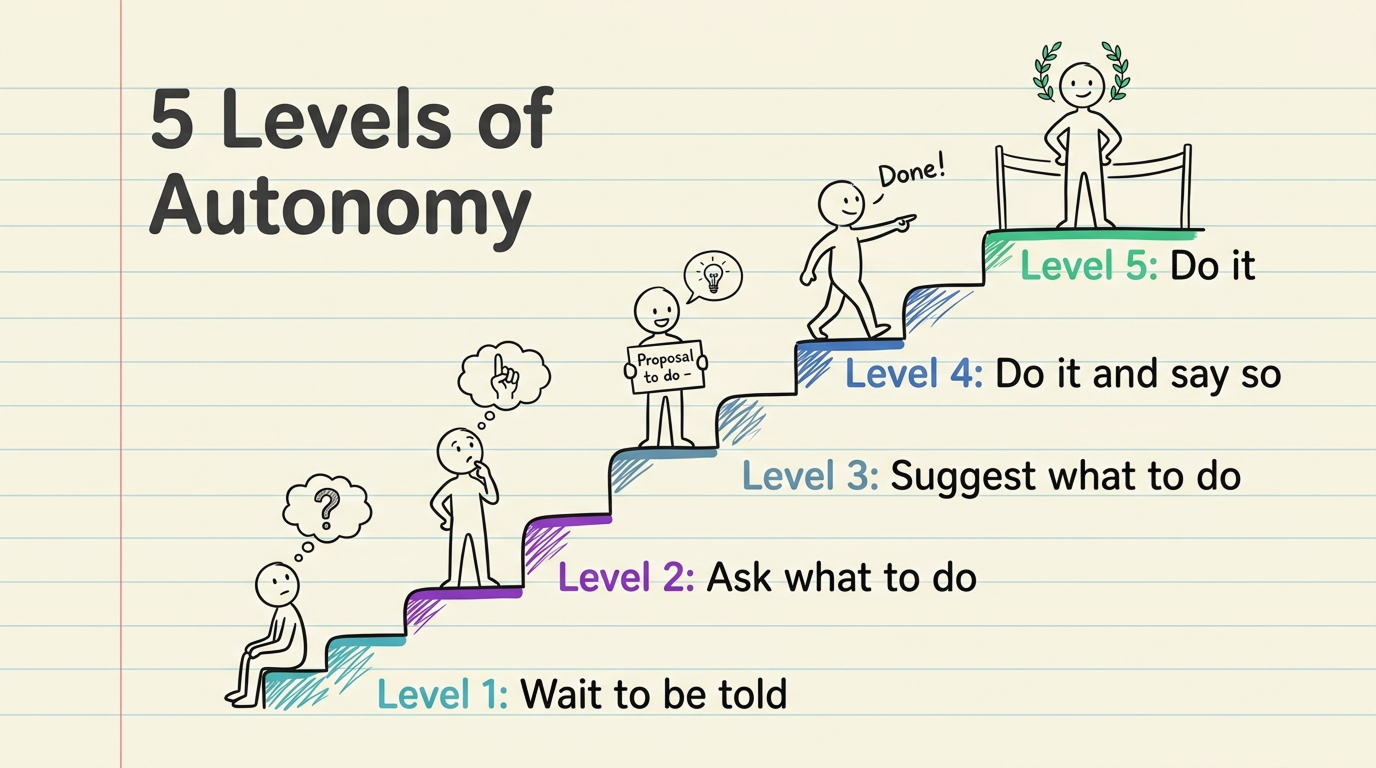
Here are the five key levels, simplified:
Level 1: Wait to be told You do what you're asked, when you're asked. Nothing more. You don't flag problems you haven't been asked about. You don't make decisions that weren't explicitly yours to make. You wait.
Level 2: Ask what to do You notice something that needs attention, but instead of acting, you go to your manager. "What should I do here?" You're engaged enough to spot the issue. You just don't trust yourself, or your mandate, to resolve it.
Level 3: Suggest what to do You come with a recommendation. "I think we should do X. What do you think?" You've done the thinking, you have a view, but you're handing the final call to someone else.
Level 4: Do it and say so You take action, then tell people what you did. "I went ahead with X. Let me know if you'd have done it differently." You've made the call, but you're keeping people informed and staying open to course-correction.
Level 5: Do it You act, and it doesn't require a debrief. You have the clarity, the competence, and the trust to just handle it. You only loop people in if something goes wrong.
Why do we hold ourselves back?
Here's what's strange: most people aren't at Level 1 because they lack skills. They're there because they're uncertain about boundaries. They don't know where their authority ends and someone else's begins. They've never been explicitly told "you can decide this." So they assume they can't.
This is especially common in new roles, new teams, or organisations with unclear decision-making norms. The path of least resistance is to ask before acting. It feels safer. It avoids stepping on toes. It keeps you from getting it wrong in public.
But the cost is real. When everyone is waiting for permission to move, things stall. Managers get overloaded with questions they shouldn't have to answer. People grow slower than they could. And the work waits.
There's also something more subtle going on: we often mislabel our own caution as respect or humility. "I didn't want to overstep." But a lot of the time, we're not protecting the organisation. We're protecting ourselves from the discomfort of being wrong.
The fear underneath it all: what if I get it wrong?
The reason people stay at Level 1 or Level 2 isn't laziness. It's risk aversion. If you wait to be told, you can't be blamed for the outcome. If you ask first, you've covered yourself. If you suggest, you've shown initiative without fully owning the result.
The higher up the ladder you go, the more exposed you are. You've made a call. It might be wrong. People might push back.
This is exactly why feedback matters so much. If you know you'll get honest feedback when you get something wrong, and that feedback will help you course-correct rather than punish you for trying, the risk calculation changes completely.
Operating at a higher level of autonomy only feels safe when the feedback loop is working.
How being open to feedback changes everything
The shift from Level 2 to Level 3 feels big. So does the shift from Level 3 to Level 4. But there's a way to make it smaller.
Try this: step up one level, and say so.
Instead of asking "what should I do here?" try: "I think we should do X. I'm going ahead, but let me know if you'd have done it differently."
Instead of bringing a recommendation and waiting for sign-off, try: "I went ahead with this. Happy to talk through the reasoning if it's useful."
You're not pretending to have certainty you don't have. You're not hiding from feedback. You're explicitly inviting it. That changes the dynamic. You're not overstepping. You're experimenting, with the loop open.
This is what being open to feedback actually looks like in practice. It's not about having thick skin or not caring what people think. It's about taking action and remaining genuinely curious about the response. The combination of initiative and openness is what makes stepping up safe, for you and for the people around you.
How to move up one level starting this week
You don't need to jump from Level 1 to Level 5. You just need to move one rung.
If you're currently waiting to be told, start noticing. What problems do you already see that you haven't flagged? Start naming them, even if you're not sure what to do about them.
If you're asking what to do, start coming with a suggestion. Do the thinking first. "Here's what I'd do. Does that make sense?"
If you're suggesting, try committing. "I'm going to do X. I'll let you know how it goes." Then do it, and report back.
If you're doing and informing, check whether the reporting is still necessary. Is your manager actually using that information, or are you updating them out of habit?
At each level, the invitation is the same: take a small step toward more ownership, and stay open to what comes back.
The role organisations play
This isn't only on individuals. If your organisation punishes people for getting it wrong when they tried to do the right thing, you'll get a workforce that waits to be told. The message lands fast: take initiative, take risk.
Leaders who want their teams to move up the ladder have to do their part. That means being clear about where people do and don't have authority. It means responding to initiative with curiosity, not defensiveness. And it means giving feedback that's actually useful: specific, timely, and focused on what to do differently rather than just what went wrong.
When people trust that taking initiative won't cost them, they take initiative. It's not complicated. It's just not always easy to build.
Frequently Asked Questions
What are the levels of autonomy at work?
The five levels of autonomy at work are: wait to be told, ask what to do, suggest what to do, do it and inform others, and do it independently. The framework was developed by L. David Marquet (the Ladder of Leadership) and describes the spectrum of initiative people take in an organisation.
Why don't people take more initiative at work?
Most people hold back because they are unclear how much authority they have. Without explicit boundaries, the safest default is to ask rather than act. Fear of getting it wrong in public also plays a role — the higher your level of autonomy, the more exposed you are, which is why a working feedback culture matters.
How do I know which level of autonomy I'm operating at?
Look at the last problem you faced at work: did you wait to be told, ask your manager, bring a recommendation, act and report back, or act on your own? Your default response shows where you currently sit on the ladder.
How can I step up to a higher level of autonomy?
Move one level at a time. If you ask what to do, start bringing a recommendation. If you recommend, act and report back. Stay open to feedback as you go — invite course-correction rather than hoping no one notices.
What's the link between feedback and autonomy?
Feedback and autonomy depend on each other. The more initiative you take, the more you need a functioning feedback loop to catch mistakes and course-correct. People step up when they trust that honest, useful feedback is available; without that trust, staying low feels safer.
Is it always better to operate at a higher level of autonomy?
No. The right level depends on your competence in the area, how clear your mandate is, and the stakes involved. Someone new in an unfamiliar role should ask more questions than a senior person who owns a clear domain. The goal is not to skip levels — it is to avoid staying below where you could reasonably operate.