 📖 Read
The SBI model: How to receive better feedback
What is the SBI Model?
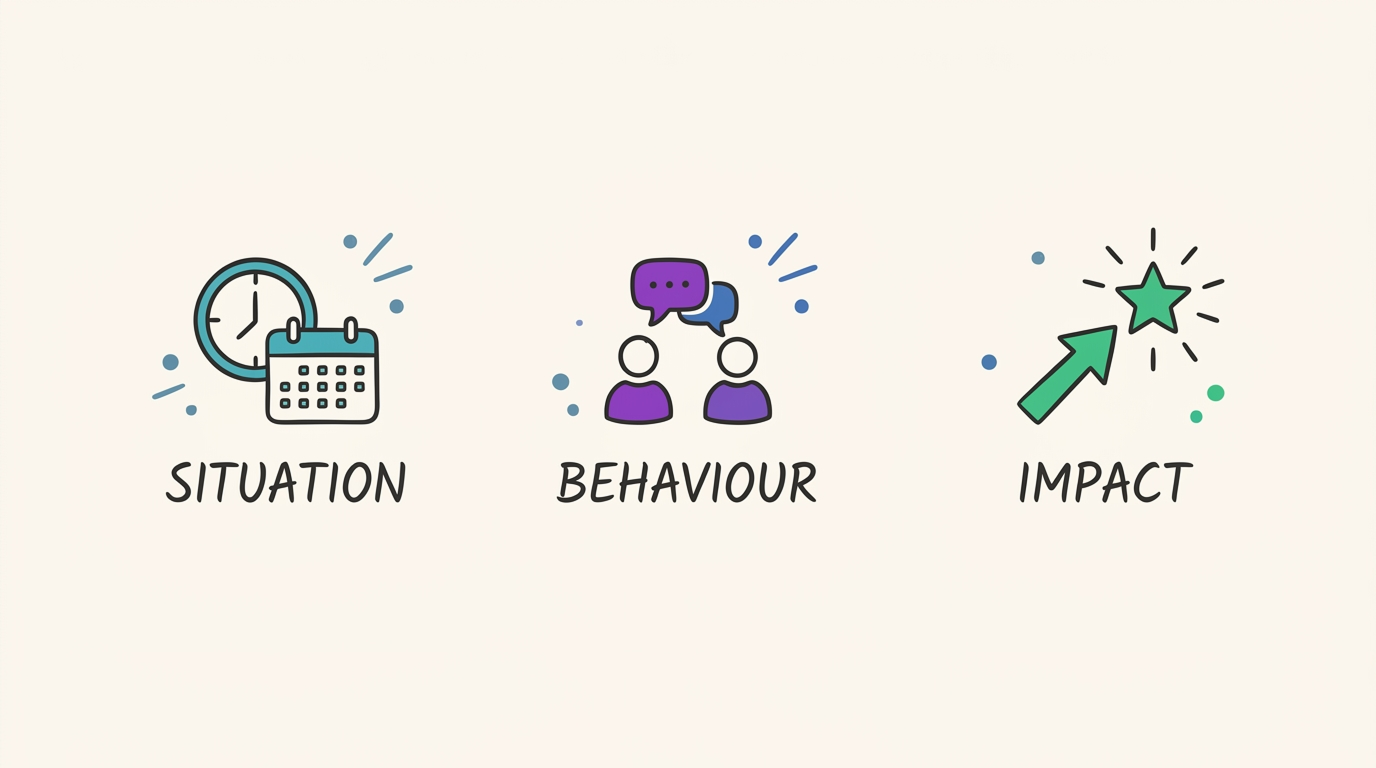
The SBI Model is a structured feedback framework developed by the Center for Creative Leadership (CCL), one of the world's leading research organisations on leadership development. SBI stands for Situation, Behaviour, and Impact.
The framework works because it anchors feedback to three specific things: a real moment in time, a concrete action, and a measurable result. Without all three, feedback stays in the territory of opinion and feeling rather than evidence and behaviour.
72% of employees said their performance would improve if their managers provided more corrective feedback.
Zenger & Folkman, "Your Employees Want the Negative Feedback You Hate to Give," Harvard Business Review, 2014
The problem is not a shortage of feedback conversations. It's a shortage of specific ones. Vague feedback tells you something is wrong without telling you what to change.
The three questions
Most people think of SBI as a tool for the person giving feedback. But you can use it from the other side. When feedback arrives without enough detail to act on, ask the provider to fill in the three blanks.
S — Situation: "Where did this happen?" Pins the feedback to a real moment. Without a specific context, you can't know what triggered the observation.
B — Behaviour: "What exactly did I do or say?" Moves from trait to action. "You were dismissive" becomes "you cut across two people before they finished speaking."
I — Impact: "What was the specific result of that action?" Shows you why it matters. The same behaviour can have different impacts depending on context. This step makes that visible.
When you receive feedback, ask for all three
You're not pushing back. You're doing the work of turning an impression into something you can act on.
Situation: "Where did this happen?"
Behaviour: "What exactly did I do or say?"
Impact: "What was the specific result of that action?"
Vague vs specific: what the difference looks like
Before (vague): "You need to work on your communication."
After SBI is applied:
- Situation: In Tuesday's stakeholder meeting.
- Behaviour: You answered the client's question before they finished speaking, and didn't address what they actually asked.
- Impact: The client looked frustrated and repeated the question. It created an awkward pause and slowed the meeting down.
The second version gives you something to work with. You know when it happened, what specifically you did, and what effect it had. That's the level of detail that leads to real change.
Why vague feedback doesn't work
When feedback is framed around traits or intentions ("you seem disengaged", "you need more confidence"), it triggers a defensive response. Your brain reads an attack on identity, not an observation about behaviour. The CCL developed SBI precisely to avoid this: by focusing on a specific action in a specific moment, feedback becomes harder to dismiss and easier to act on.
As receivers, we often accept vague feedback without asking for more. We assume we understand what was meant, or we feel too awkward to probe. But vague feedback that goes unexamined doesn't help you grow. It just creates a vague sense that something is wrong.
The Center for Creative Leadership has trained over 2 million leaders across 160 countries using this framework. The model is grounded in behavioural psychology: separating observation from interpretation makes feedback less threatening and more actionable.
Frequently asked questions
Can I use SBI in any feedback conversation? Yes. SBI applies in any context where feedback is given or received: performance reviews, peer feedback, one-to-ones, or informal conversations. The framework is simple enough to use in the moment without needing to explain it.
What if the person giving feedback can't answer the questions? That's useful information too. If someone can't point to a specific situation or behaviour, the feedback may be based on a general impression rather than observed evidence. You can acknowledge what they said and ask them to come back with an example when they have one.
Is it okay to ask these questions if the feedback is positive? Absolutely. SBI works equally well for reinforcing feedback. Knowing the specific behaviour that had a positive impact helps you repeat it deliberately, rather than hoping you'll accidentally do it again.
Who developed the SBI feedback model? The SBI model was developed by the Center for Creative Leadership (CCL), a research-based organisation that has studied leadership development since 1970. It remains one of the most widely used feedback frameworks in leadership and professional development.
Downloads