 ✍ Blog
One behaviour, many views: Why feedback labels are dangerous
Have you ever given a colleague what you thought was a perfectly honest critique, only to find out they thought you were being "nasty"? Or perhaps you considered yourself "passionate" about a project, but your manager labeled you "emotional"?
In the modern workplace, feedback is hailed as the ultimate tool for growth. But more often than not, it becomes a weapon of misinterpretation.
As highlighted in the groundbreaking book Thanks for the Feedback (2014) by Douglas Stone and Sheila Heen, human beings have a critical flaw when it comes to communication: we label behaviours instead of describing them. Here is why feedback labels are failing your team, and how to fix them to build a high-performing culture.
What is a Feedback Label?
Direct Answer: A feedback label is a subjective, one-word summary or adjective used to describe someone's behaviour (e.g., calling someone "arrogant" instead of "smart," or "hypercritical" instead of having "high standards"). Feedback labels fail because they mask the actual data behind an action, leading to defensiveness, cognitive bias, and misaligned expectations.
One Behaviour, Many Views: The Distortion of Subjectivity
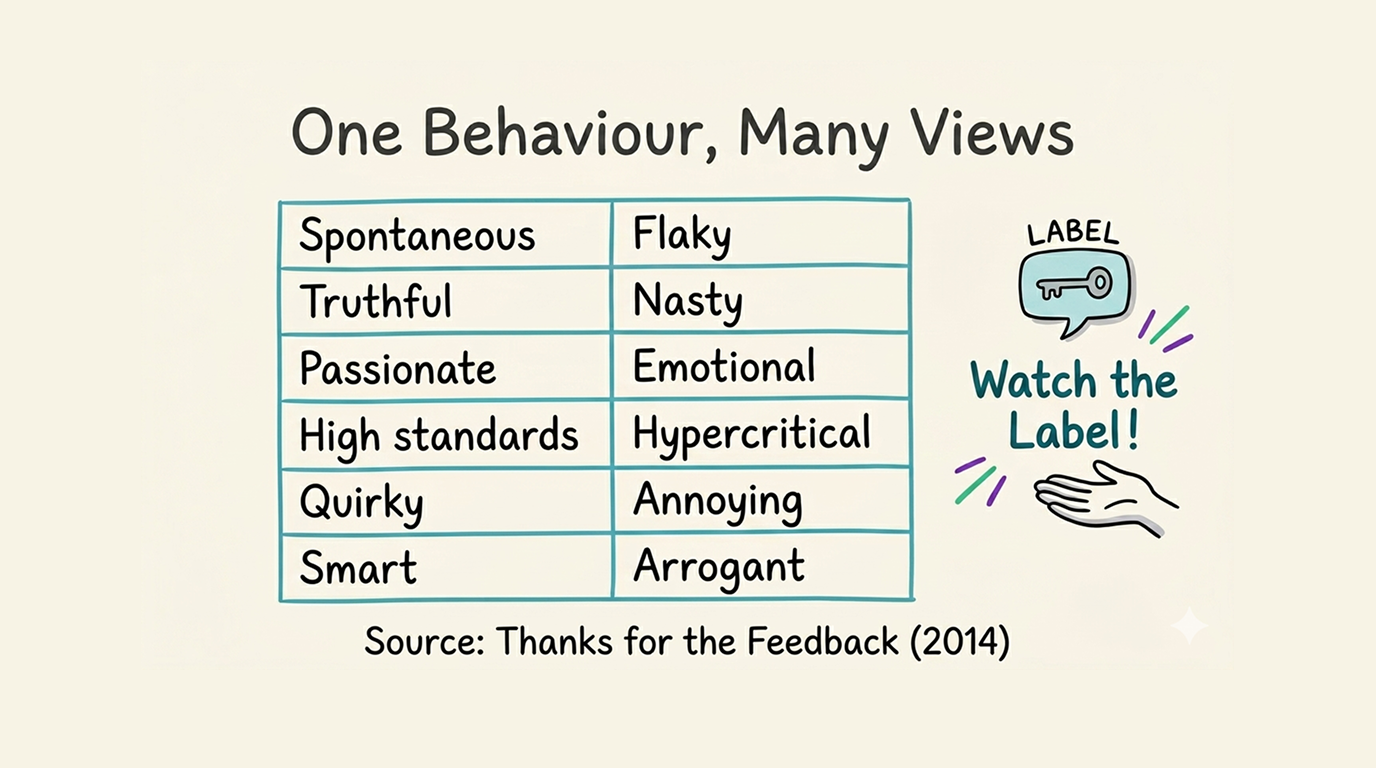
The core issue with feedback labels is that one behaviour can yield entirely different views depending on the observer's perspective. Consider the contrasting labels popularised by Stone and Heen's research:
| The Positive Intent / View | The Negative Interpretation / Label |
|---|---|
| Spontaneous | Flaky |
| Truthful | Nasty |
| Passionate | Emotional |
| High standards | Hypercritical |
| Quirky | Annoying |
| Smart | Arrogant |
When we slap a label on a colleague, we act as if the label is an objective fact. In reality, a label is just a judgment wrapped in an adjective.
The Science of Why Labels Fail: What the Research Says
To understand why labels trigger such a negative psychological response, we have to look at cognitive science.
1. The Fundamental Attribution Error
Psychological research shows that humans suffer from the Fundamental Attribution Error. When we observe someone else making a mistake, we attribute it to their character (e.g., "They missed the deadline because they are flaky"). However, when we miss a deadline, we attribute it to external circumstances (e.g., "I missed the deadline because the client changed the requirements"). Labels lock people into character flaws rather than addressing situational behaviours.
2. Labels Trigger the Brain's Threat Response
According to neuroscientific research on the SCARF model (Status, Certainty, Autonomy, Relatedness, Fairness), receiving a negative label directly attacks a person's Status and Fairness. When a brain perceives a threat to status, it goes into fight-or-flight mode. The moment you call an employee "hypercritical," their prefrontal cortex shuts down, and they stop listening to the actual substance of your critique.
3. The "Identity Trigger"
In Thanks for the Feedback, the authors discuss Identity Triggers. Labels cause an immediate "all-or-nothing" identity crisis. If an employee prides themselves on being smart, and a manager labels a comment they made as "arrogant," the employee's identity is threatened. They pivot from trying to improve to defending their character.
How to Respond When Someone Labels You
When you receive a label, the instinct is to defend yourself. But there is a more useful move: ask for the data behind it.
Labels are shortcuts. When someone calls you "flaky" or "arrogant," they are compressing an observation, an interpretation, and a feeling into a single word. Your job as the recipient is to uncompress it. That starts with curiosity, not defence.
Ask for the specific behaviour
The most direct question you can ask is: "Can you help me understand what you observed that led you to that conclusion?"
You are not challenging the label. You are asking for the underlying data. Most people, when asked, will shift from the adjective to the actual moment. "You missed the last two check-ins" is something you can work with. "You're flaky" is not.
Other questions that open this up:
- "What did I do or say specifically?"
- "When did you notice this?"
- "Is there a particular situation you have in mind?"
Ask about the impact
Once you have the specific behaviour, ask what the consequence was: "How did that land for you, or for the team?"
This gives you information about why the label carries the weight it does. It also signals that you are genuinely trying to understand, not just waiting for the conversation to be over.
Hold the label lightly
You do not have to accept a label as true to take the underlying feedback seriously. The label is one person's interpretation of one or more specific moments. When you separate the label from the data, it becomes easier to stay open. "You're arrogant" is hard to sit with. "In that meeting, you interrupted the client twice before they finished speaking" is something you can reflect on without it threatening your entire sense of who you are.
Frequently Asked Questions
Why is feedback often misinterpreted?
Feedback is often misinterpreted because the giver focuses on judgments (labels) while the receiver focuses on their own intent. Because people judge themselves by their intentions and others by their behaviour, a mismatch occurs.
What book covers "One Behaviour, Many Views"?
The concept of "One Behaviour, Many Views" and the dangers of feedback labels is extensively covered in the 2014 book Thanks for the Feedback: The Science and Art of Receiving Feedback Well by Douglas Stone and Sheila Heen.
What do I say when someone labels me?
Start by asking for specifics. "Can you help me understand what you observed that led to that?" is a good place to begin. From there, ask about the impact. Your goal is to get from the adjective to the actual moment, so you have something concrete to reflect on rather than an adjective to argue with. The three steps follow the SBI model (Situation, Behaviour, Impact), applied from the receiver's side rather than the giver's.
Conclusion: Get Underneath the Label
The next time someone gives you a label, resist the urge to defend or dismiss. Ask what they observed. Ask what the impact was. The label tells you how someone felt. The data underneath it gives you something you can actually use.